Okonomiyaki is one of those dishes that’s hard to explain to someone who’s never had it, but the moment they take a bite they completely understand why you made them try it.
The closest shorthand is “Japanese savory pancake,” but that undersells it significantly. It’s also been called Osaka soul food and Japanese pizza, and while neither of those is exactly right either, they’re both getting at the same idea. This is comfort food. Deeply satisfying, endlessly customizable, and the kind of thing that becomes a regular in your rotation once you’ve made it once.
The Blackstone griddle is the perfect tool for this recipe. Okonomiyaki is traditionally made on a teppan, a flat iron griddle, either in a restaurant or right at the table. The wide flat surface of the Blackstone is essentially a backyard teppan, which means this is one of those rare recipes where the outdoor griddle isn’t a substitute for the traditional cooking method. It IS the traditional method.
What Does Okonomiyaki Mean?
The name is actually a perfect description of the dish. It breaks down into two words.
Okonomi means “as you like it” or “what you want.” Yaki means “grilled.” So okonomiyaki is literally “grilled as you like it,” and the name is not an exaggeration. The base batter and shredded cabbage stay consistent, but everything else is up to you. Protein, mix-ins, toppings, all customizable. It’s a framework more than a fixed recipe, which is a big part of why it’s become such a staple in Japanese home cooking and street food culture.
The version I make here uses crispy pork belly as the protein, specifically the Sous Vide Asian Pork Belly from this site, sliced and crisped up on the griddle before the batter goes on top. It’s a combination that’s hard to beat. But the filling ideas and substitutions below will get you to a great result with whatever you have on hand.
The Batter: What You Need to Know
Traditional okonomiyaki batter includes nagaimo, a Japanese mountain yam that gets grated and mixed in to give the batter a light, almost airy texture that’s different from a regular pancake. It’s available at Asian grocery stores but can be hard to find elsewhere.
For this recipe I substitute baking soda, which mimics some of that lift, along with panko breadcrumbs in place of traditional tempura scraps. These are easy substitutions that work well and keep the ingredient list manageable without a trip to a specialty store.
Dashi broth is the other traditional ingredient worth seeking out if you can. It’s a Japanese stock made from kombu seaweed and dried bonito flakes, and it adds a savory, umami depth to the batter that plain water just doesn’t have. Instant dashi powder is available at most Asian grocery stores and online. A little goes a long way and it keeps forever. If you can’t find it, water works fine, but dashi is worth the effort if you can get it.
The Pork Belly Method
The technique here is what makes the pork belly version so good. Instead of mixing the protein into the batter, the pork belly goes down on the hot griddle first and cooks until browned on one side. Then the batter gets poured directly over the top of the meat, covering it completely. The pancake cooks around and over the pork belly, and when you flip it the pork belly ends up on top, crispy side up, perfectly integrated into the pancake.
If you’re using the Sous Vide Asian Pork Belly recipe, slice it into thin pieces before it hits the griddle. The sous vide process has already cooked it through, so you’re just crisping up the exterior before the batter goes on. If you’re using raw bacon instead, make sure it’s mostly cooked before adding the batter. Undercooked bacon in the middle of a pancake is not what you’re going for.
Getting the Flip Right
The flip is the moment that makes or breaks okonomiyaki. These are thick pancakes, somewhere between half an inch and an inch, and they need to be structurally set before you try to turn them. Flip too early and the batter is still liquid in the middle and the whole thing falls apart.
The tell is the edges. When the edges of the pancake look set and matte rather than wet and shiny, and the bottom has developed a golden brown crust you can see when you peek underneath with a spatula, it’s ready to flip. This usually takes about 5 minutes on medium-low heat.
Use two spatulas for the flip if you’re not confident with one. Get one spatula fully under the pancake and use the second to support the top as you turn it. Go decisively. A slow hesitant flip causes more problems than a quick committed one.
The Toppings Are Not Optional
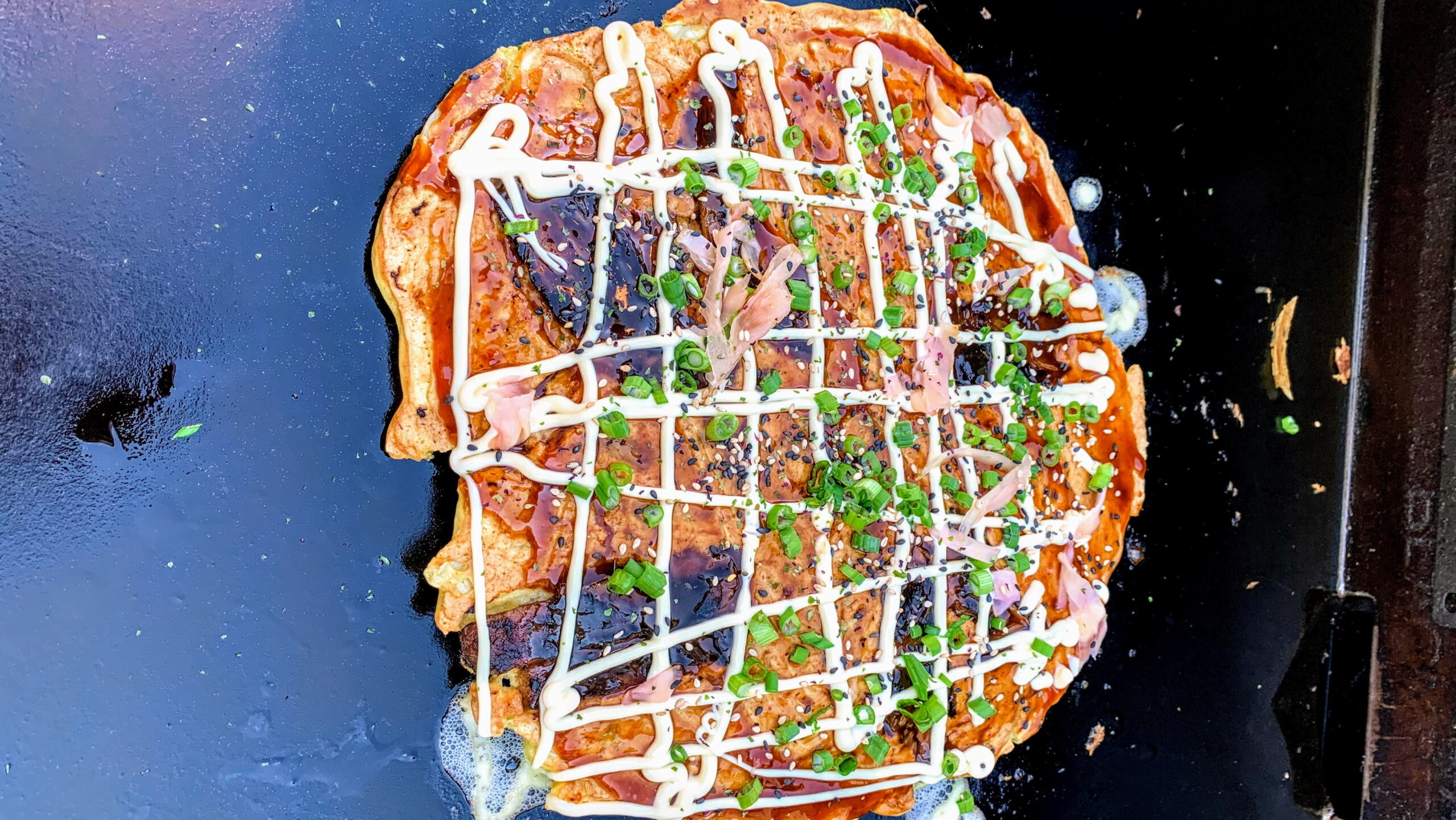
A plain okonomiyaki without toppings is like a pizza without sauce and cheese. Technically edible but missing the point entirely. The combination of okonomiyaki sauce, Japanese mayo, scallions, sesame seeds, aonori, and bonito flakes is what takes it from “savory pancake” to something genuinely special.
The bonito flakes in particular are worth tracking down. They’re dried, shaved fish flakes that do something remarkable when they hit the hot pancake. The heat makes them wave and dance like they’re alive. It’s one of the more visually striking things that happens in home cooking and it never gets old to watch.
All of these toppings are available at Asian grocery stores and most are easy to find online. Once you have them they keep well and you’ll find yourself reaching for them on other dishes too.
Filling Ideas
Mix and match to build your pancake:
- Bacon or pork belly (the classic choices)
- Shrimp
- Calamari
- Scallops
- Octopus
- Pickled red ginger (beni shoga or kizami beni shoga, sushi ginger works as a substitute)
- Scallions
- Bean sprouts
- Corn
- Mushrooms
- Kimchi
- Garlic
Topping Ideas
Layer these on in order after the flip, finishing with the bonito flakes right before serving:
- Dried bonito flakes
- Okonomiyaki sauce (recipe below)
- Japanese mayo (Kewpie is the brand to use, it’s richer and slightly sweeter than American mayo)
- Chopped scallion greens
- Sesame seeds
- Aonori (dried seaweed flakes)
- Pickled red ginger
- Dried bonito flakes
Okonomiyaki
Ingredients
Okonomiyaki Batter
- 1 and 2/3 cups all-purpose flour
- 1 tsp baking soda in place of nagaimo
- 1/2 tsp baking powder
- 1/2 tsp sea salt
- 1/2 cup panko breadcrumbs in place of tempura scraps
- 2 cups water or dashi broth
- 4 large eggs
- 3 cups packed shredded cabbage
- 1 bunch scallions whites chopped (reserve greens for topping)
- 2 tbsp pickled ginger roughly chopped
- 1/2 lb bacon or pork belly
Okonomiyaki Sauce
- 4 tbsp ketchup
- 1 and 1/2 tbsp honey or brown sugar
- 2 tbsp oyster sauce
- 3 and 1/2 tbsp Worcestershire sauce
Toppings
- Okonomiyaki sauce
- Japanese mayo Kewpie
- Chopped scallion greens
- Sesame seeds
- Aonori dried seaweed flakes
- Dried bonito flakes
- Pickled red ginger
Instructions
Okonomiyaki Sauce
- Combine the ketchup, honey or brown sugar, oyster sauce, and Worcestershire sauce in a small bowl and whisk until smooth. Taste and adjust sweetness or tanginess as needed. Refrigerate until ready to use. Can be made days ahead.
Batter
- Combine the flour, baking soda, baking powder, salt, and panko in a large bowl and whisk together.
- Make a well in the center and add the eggs and dashi broth or water. Whisk the wet ingredients in the well, then slowly incorporate the dry ingredients until just combined. Do not overmix, some lumps are fine.
- Fold in the shredded cabbage, scallion whites, and pickled ginger. The batter will be thick.
- Let the batter rest for 5 to 10 minutes while you preheat the griddle.
Cook
- Preheat the Blackstone to medium-low heat and let it fully come up to temperature.
- Add the bacon or pork belly to the griddle and cook until browned on one side, about 3 to 4 minutes. If using pre-cooked sous vide pork belly, just crisp up the surface.
- Flip the bacon or pork belly and immediately pour the batter directly over the meat, covering it completely. Keep the batter between 1/2 inch and 1 inch thick.
- Cook on medium-low until the edges look set and matte and a golden brown crust has formed on the bottom, about 5 minutes. Peek underneath with a spatula before flipping.
- Flip decisively using two spatulas if needed. Cook the second side for 4 to 5 minutes until cooked through. The pancake should feel firm when pressed lightly in the center.
- While still hot apply toppings in order: okonomiyaki sauce, Japanese mayo, scallion greens, sesame seeds, aonori, and pickled ginger. Add bonito flakes last right before serving.
- Serve immediately on the griddle or transfer to a plate and cut into wedges.
Video
Notes
Tips for the Best Okonomiyaki
Don’t rush the cook. Medium-low heat is the right call here. The pancakes are thick and need time to cook through without burning the outside. Patience pays off. Keep them a reasonable size. Aim for about 6 to 8 inches in diameter. Bigger pancakes are harder to flip cleanly and harder to cook evenly. Two smaller ones beats one giant one every time. Rest the batter. That 5 to 10 minute rest after mixing gives the flour time to fully hydrate and the cabbage time to start releasing a little moisture, which improves the final texture. Get Kewpie mayo. Regular American mayo works in a pinch but Kewpie, the Japanese brand in the squeeze bottle with the baby on it, has a richer, slightly tangier flavor that’s noticeably better here. Asian grocery stores carry it consistently and it’s widely available online.What to Serve With Okonomiyaki
Okonomiyaki is a complete meal on its own, but if you’re building a bigger spread these all work well alongside it:- Miso soup, a classic Japanese pairing that complements the savory flavors
- Steamed white rice, simple and neutral
- Japanese cucumber salad, cool and refreshing as a contrast to the rich pancake
- Cold Japanese beer or sake, the traditional pairing and for good reason
Once you make okonomiyaki on the Blackstone you’ll see why this is one of the most beloved street foods in Japan. The griddle is the right tool for the job, the toppings are half the fun, and the whole thing comes together faster than you’d think. Make it once and it’ll be in regular rotation by summer.