I have a complicated relationship with corned beef hash at diners.
On one hand, corned beef hash with poached or over-medium eggs is one of my favorite things to order for breakfast. On the other hand, what actually shows up on the plate at most diners is a disappointment, too salty, weirdly processed tasting, and bearing an uncomfortable resemblance to something that came out of a can. Which, at a lot of places, it did.
So I stopped ordering it at diners and started making it at home. And once you’ve had homemade corned beef hash made from real ingredients on a hot Blackstone griddle, the canned stuff is genuinely hard to go back to.
The Blackstone is what makes this recipe. The wide, flat cooking surface lets you spread everything out in a single layer, which means maximum contact with the hot steel and maximum crust development on the potatoes. That crust is everything. It’s the difference between hash that’s just cooked and hash that’s genuinely great.
Why the Blackstone Is Perfect for Hash
Hash is fundamentally a high-heat, high-surface-area recipe. You want the ingredients spread out, not piled up, so everything gets direct contact with the cooking surface. A standard skillet can do this for one or two portions. The Blackstone can do it for four without any compromise.
The other advantage is temperature control across zones. You can have one area of the griddle ripping hot for the potatoes while another zone runs medium for the peppers and onions, then bring everything together at the end. That kind of control is hard to replicate on a single burner stovetop setup.
If you don’t have a Blackstone, a large cast iron skillet or a stainless steel pan over high heat gets you close. But if you’ve been on the fence about a flat top griddle, this is one of those recipes that makes the purchase obvious.
The Corned Beef Question
The single biggest upgrade you can make to homemade hash is using good corned beef. Skip the canned stuff entirely — that’s where most of the excessive saltiness and processed flavor comes from.
Instead, head to your deli counter and ask them to slice corned beef about a quarter to half an inch thick. That thickness gives you pieces that hold their shape when you dice them and get some texture and browning in the pan, rather than disintegrating into mush. Most grocery store deli counters will do this without any issue.
If you have leftover homemade corned beef, even better. Homemade corned beef can be shredded rather than diced, which gives the hash a slightly different texture — a little more rustic and less uniform, which I actually prefer. Either way works.
The deli counter approach is the weekday shortcut. Leftover homemade corned beef is the weekend version when you’ve planned ahead.
The Microwave Potato Trick
Potatoes are the sticking point in most hash recipes. If you try to cook raw diced potatoes from scratch on the griddle, you end up with either underdone potatoes or everything else overcooked while you wait for them to catch up.
The solution is a quick microwave par-cook before anything hits the griddle. Six to eight minutes in the microwave gets the potatoes to just tender — cooked through but still firm enough to hold their shape and develop a proper crust when they hit the hot steel. This step takes almost no effort and completely solves the timing problem.
You want them tender but with some resistance when you push a fork in. If they’re falling apart in the microwave they’re overdone and will turn to mush on the griddle. Pull them early rather than late.
The Most Important Rule: Don’t Touch the Potatoes
Once the potatoes go down on the hot griddle, leave them alone. This is the hardest part of the recipe for most people because the instinct is to keep stirring and moving things around.
Resist that instinct.
The crust forms from sustained contact between the potato and the hot cooking surface. Every time you move them you’re breaking that contact and starting the process over. Let them sit until a proper golden-brown crust has formed on the bottom — you’ll see it starting to develop around the edges — then flip once and repeat on the other side. The same principle applies whether you’re using a Blackstone or a cast iron pan.
Tips for the Best Corned Beef Hash
Season in layers. Add salt, pepper, and garlic powder at each stage of cooking — to the peppers and onions, to the potatoes, to the corned beef — rather than seasoning everything at the end. Layered seasoning builds more depth of flavor than a single seasoning at the finish.
Don’t crowd the griddle. Spread everything out. Crowded ingredients steam instead of sear, which means no crust and a lot of sogginess. If your griddle or pan feels overcrowded, work in batches.
Brown the corned beef separately. Give the corned beef its own time on the hot griddle before combining everything. You want a little caramelization on the edges of the meat — that browning adds flavor and texture that you lose if it just gets dumped in with everything else.
Combine at the end. Cook each component to the point where it’s done and tasty on its own, then bring everything together at the end for a final toss and seasoning check. This way nothing gets overcooked waiting for something else to catch up.
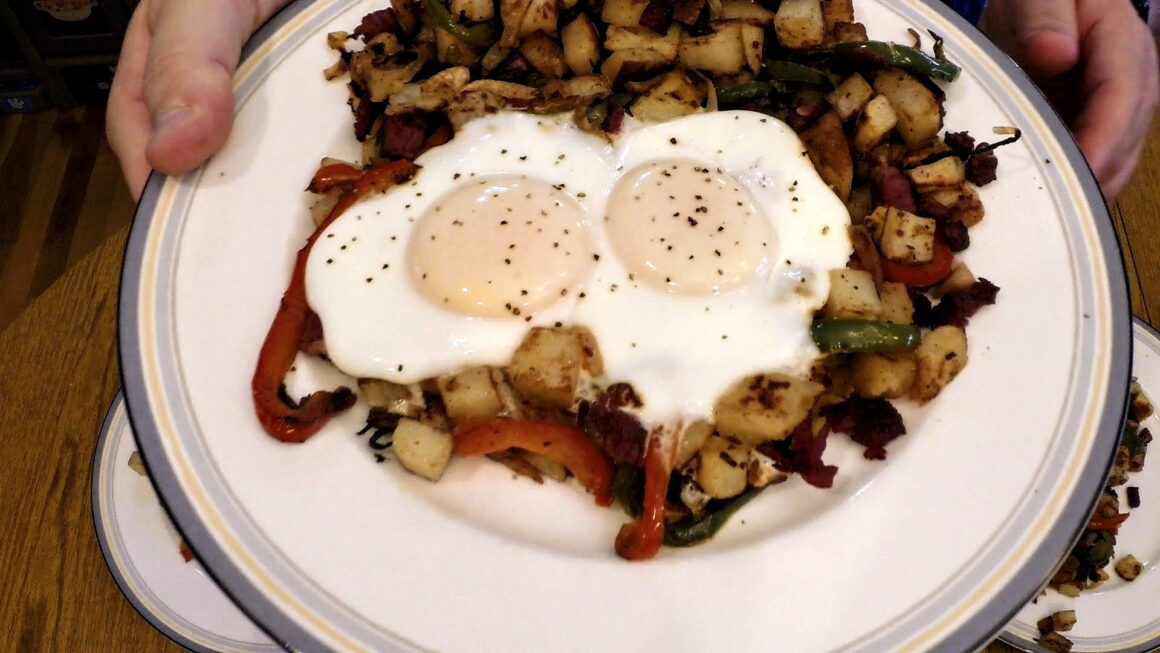
Serve with eggs. This is non-negotiable in my house. Poached eggs or over-medium eggs on top, with the yolk running down into the hash, is the only proper way to eat this. A fried egg works too. Scrambled eggs, while perfectly fine on their own, miss the point here.
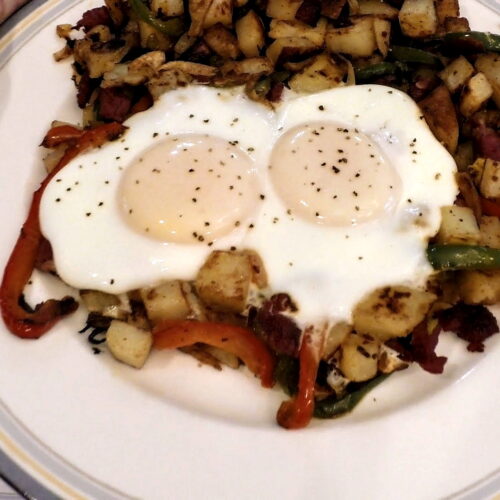
Corned Beef Hash
Ingredients
- 4 medium russet potatoes
- 1 large onion or 2 small, thinly sliced
- 1 medium green bell pepper thinly sliced
- 1 medium red bell pepper thinly sliced
- 1/2 lb deli corned beef sliced 1/4 to 1/2 inch thick and diced (or shredded leftover homemade corned beef)
- oil for cooking vegetable or canola
- salt pepper, and garlic powder to taste
Instructions
- Par-cook the potatoes. Peel the potatoes and dice into 1/2 inch cubes. Place in a microwave-safe bowl and microwave for 6-8 minutes, stirring once halfway through, until just tender with some resistance when pierced with a fork. They should not be falling apart. Set aside. If no microwave is available, boil the diced potatoes until just tender with some resistance when pierced with a fork. Then drain and allow the outside to dry slightly.
- Prep the corned beef. Dice the deli corned beef into 1/4 to 1/2 inch pieces. If using leftover homemade corned beef, shred it with your hands or two forks.
- Preheat the Blackstone. Get your griddle up to medium-high heat. Give it a few minutes to fully come up to temperature — you want it hot enough that a drop of water dances and evaporates immediately.
- Cook the peppers and onions. Add a drizzle of oil to the griddle and add the sliced peppers and onions. Season with salt, pepper, and garlic powder. Cook, stirring occasionally, until softened and starting to get some color on the edges, about 8-10 minutes. Push to the side or a cooler zone of the griddle when done.
- Crust the potatoes. Add a few tablespoons of oil to the hot zone of the griddle and spread the par-cooked potatoes out in a single layer. Season with salt, pepper, and garlic powder. Let them cook undisturbed until a deep golden-brown crust forms on the bottom, about 5-7 minutes. Flip once and repeat on the other side. Work in batches if needed to avoid crowding.
- Brown the corned beef. Push the potatoes aside and add a little more oil if needed. Add the diced corned beef in a single layer and let it sear for 2-3 minutes per side until browned and slightly crispy on the edges.
- Combine and finish. Bring the peppers, onions, potatoes, and corned beef together on the griddle. Toss gently to combine and cook for another 2-3 minutes. Taste and adjust seasoning with salt, pepper, and garlic powder as needed.
- Serve. Plate immediately and top with poached, over-medium, or fried eggs.
Video
Notes
What to Serve With Corned Beef Hash
- Poached or over-medium eggs — the runny yolk is a sauce. Don’t skip it.
- Toast or English muffins — for soaking up everything on the plate
- Hot sauce — a few dashes of Tabasco or your favorite hot sauce cuts through the richness perfectly
- Fresh fruit — a simple fruit salad on the side keeps the meal from being too heavy
Make It a Full Blackstone Breakfast
The Blackstone really shines when you’re cooking for a group. While the hash is going on one zone, you can cook eggs on another, throw some bacon or sausage on a third, and have everything ready at the same time. It’s one of the best arguments for the flat top griddle as an outdoor breakfast station.
If you’re looking for more Blackstone breakfast ideas, check out the Pork Belly Okonomiyaki — another great flat top recipe that works well as part of a bigger breakfast spread.
Once you make hash from scratch on the Blackstone you’ll understand why diner hash is such a letdown. Real ingredients, proper crust on the potatoes, good corned beef from the deli counter — it’s a completely different dish. Make it on a Saturday morning with eggs on top and it’ll become a regular in your rotation.